
Transcript
Announcer:
Welcome to CME on ReachMD. This activity, titled “Optimizing IgAN Care: Achieving Lower Proteinuria Targets With Combination Therapy” is provided by Medtelligence. Prior to beginning the activity, please be sure to review the faculty and commercial support disclosure statements as well as the learning objectives.
Dr. Barratt:
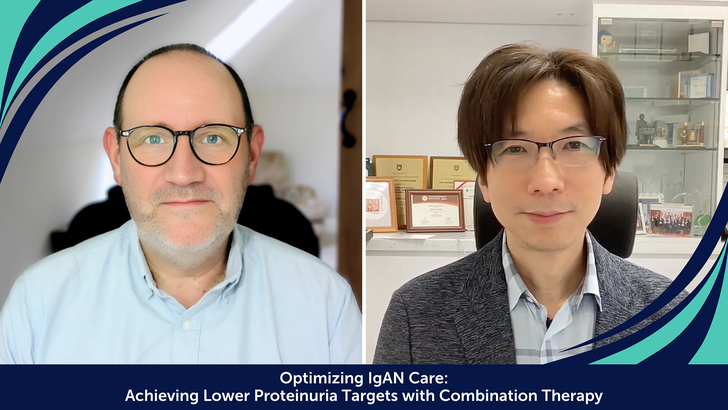
Hello. Today on Clinical Countdown, Optimizing IgA Nephropathy Care: Achieving Lower Proteinuria Targets with Combination Therapy, we're reviewing how to achieve lower proteinuria targets with combination therapy in patients with IgA nephropathy. I'm Professor Jonathan Barratt from the University of Leicester in the UK, and joining me today is my good friend Professor Sydney Tang from Hong Kong.
Dr. Tang:
Hi there. Thanks, John. I'm Sydney Tang from the University of Hong Kong.
Dr. Barratt:
I've been thinking for some time that IgA nephropathy may not be a single disease, because whenever I travel around the world, particularly to your part of the world, the patients you look after with IgA nephropathy are completely different in terms of their presentation and their speed of loss of kidney function than the patients I look after in the UK. What do you think about that?
Dr. Tang:
Well, I really can't agree with you more, John, on this, because of the variation in epidemiology, in clinical course, and even in responses to treatment in patients in different parts of the world. In my part of the world, patients present with heavier proteinuria, steeper eGFR decline than your patients. So I do believe that patients behave differently.
Dr. Barratt:
So we're starting to see that reflected in international guidelines and that there may be nuances in terms of how we should approach and treat patients with IgA nephropathy. And that brings me on to the recent update in the KDIGO 2024—or now going to be 2025—IgA nephropathy guideline. Because there, we're stressing very much the importance of early diagnosis, we're stressing the importance of patients being at risk of kidney failure with relatively low levels of proteinuria, and we're stressing the importance of getting proteinuria down as low as possible, with the hope that that will translate to a reduction in the rate of loss of kidney function. Because what our aspiration is, is to get the rate of loss of kidney function down to the physiological state that we see in a healthy person. Now that's a big challenge, but I think that's the way forward if we're going to prevent kidney failure in the lifetime of our patients with IgA nephropathy.
So on that background, let's take a look at IgA nephropathy treatment, starting first with sparsentan, because of emerging data that was presented very recently. So, Sydney, would you like to take us through that.
Dr. Tang:
Well, first of all, let's look at the mechanism of action of sparsentan. It is a dual endothelin–angiotensin receptor antagonist, or DEARA in short. And obviously it blocks 2 receptors simultaneously. It is a non-immunosuppressive agent.
And I think the results from the PROTECT study that was published in 2023 from 400 patients with IgA nephropathy showed that sparsentan can reduce proteinuria compared with irbesartan, and it can also slow the decline in eGFR. And over a 2-year period, there was a 1.1 mL/min/1.73 m2/year difference between the treatment group and the control group.
Dr. Barratt:
And I really like this study, because unlike any other IgA nephropathy study, there was an active comparator. By that, I mean that all patients were started on treatments, either with irbesartan or sparsentan. And in both cases, there was up-titration to the maximum tolerated dose within the trial. And so we know the treatment effect we're seeing is a comparison against what we would expect to see on a maximal renin–angiotensin system blocker.
And I think that's really important, because we know in clinical practice that even though we say patients should be on maximal RAS blockade, there really isn't that occurring in many IgA nephropathy patients.
Dr. Tang:
Yeah. Awesome. Well, moving on, John, what about the evidence for the SGLT2 inhibitor for IgA nephropathy?
Dr. Barratt:
We need to accept there haven't been any IgA nephropathy–specific SGLT2 inhibitor trials and, in particular, trials in the patient populations that we generally recruit into IgA nephropathy trials.
But there are a large number of IgA nephropathy patients both in the DAPA-CKD trial of dapagliflozin and the EMPA-KIDNEY trial of empagliflozin. And in those 2 studies, when we look at the IgA nephropathy patients included, they behaved very similar to the general non-diabetic CKD patients. So there is evidence that SGLT2 inhibition can be beneficial in patients with IgA nephropathy.
But the important thing to note—and this is a nuance here—is that the IgA nephropathy patients included in these SGLT2 inhibitor trials actually were older, with more advanced disease than we see in the general IgA nephropathy population. So while we do have data in IgA patients with established CKD at the advanced end of the spectrum that adding an SGLT2 inhibitor may be beneficial, I'm not so sure we have robust evidence that we should be starting an SGLT2 inhibitor immediately in our young patients when they present to us. And that nuance is present in the recent update of the KDIGO guideline.
Now, I wish I could explain to you how SGLT2 inhibitors work, just like you did with sparsentan in terms of that dual receptor antagonism, but really, we just don't know how SGLT2 inhibitors work. We know they reduce intraglomerular pressure. We know they enhance glucose excretion in the urine. But there are lots and lots of other hypotheses about how they may be beneficial, both in and out of the kidneys, with no firm data to absolutely secure any particular mechanism of action.
Dr. Tang:
I think the 2 trials you mentioned, the DAPA-CKD and EMPA-KIDNEY, were really not IgA nephropathy–specific studies. They recruited patients with non-diabetic CKD on top of patients with diabetes. And what we observed consistently from these 2 trials was actually the degree of proteinuria reduction and kidney protection alongside cardiovascular protection in this spectrum of patients with CKD. And we really don't know if the SGLT2 inhibitor has any specific action on IgA nephropathy.
Dr. Barratt:
Yeah, Sydney. I mean, I couldn't agree more. But now that we've reviewed the evidence for sparsentan and SGLT2 inhibition independently, let's discuss the recent data for using them in combination.
Dr. Tang:
I think one important goal laid down by KDIGO was, as you mentioned earlier, a more aggressive goal towards proteinuria reduction to preferably more than 0.3. So if both agents are able to reduce proteinuria in patients with IgA nephropathy, I think there's this theoretical basis that we should study how this combination could benefit patients with IgAN and how they could actually achieve maybe more proteinuria reduction and possibly also to preserve kidney function.
So the SPARTACUS phase 2 study was actually a study designed to add a DEARA—or sparsentan—to patients who are already on a stable dose of SGLT2 inhibitor and a RAS inhibitor and look at the degree of proteinuria reduction in the patients.
So I think the phase 2 study actually showed among 48 patients that the addition of sparsentan to patients already on an SGLT2 inhibitor and a RASi demonstrated a significant early reduction in proteinuria. And by the end of the follow-up at 24 weeks, there was a 56% reduction in UACR compared with baseline.
And if we look at the percentage of patients who were able to achieve proteinuria reduction to less than 0.2 g/g, it was around 30%. The percentage of patients who achieved a 50% or more reduction in UACR from baseline was 50%, and something like 77% of patients actually achieved 30% or more reduction in uACR over baseline.
And I think importantly in the SPARTACUS study, there was no signal for adverse events. I think around 15% of patients actually experienced hypotension. But overall, there was actually no important adverse events.
And I think there was also a real-world study data published in 2024 that among—I think around 23 patients who were actually also already on a stable dose of an SGLT2 inhibitor who then received sparsentan, they actually achieved an astounding 62% reduction in proteinuria at 24 weeks. And I think around 90% of patients actually experienced a 50% or more reduction in proteinuria. And once again, there was actually no issue on safety.
So I think these are the latest results from SPARTACUS and also a real-world study showing the efficacy of this combination, sparsentan and an SGLT2 inhibitor.
Dr. Barratt:
And so the data that you've just discussed, Sydney, from SPARTACUS, and the real-world data, actually, shows that you are getting additional benefit by combining both of these approaches and that it's a safe thing to do in our patients.
So, Sydney, considering all of the evidence that we've discussed—and in particular evidence we haven't discussed in terms of the natural history of IgA nephropathy and that significant lifetime risk of kidney failure—it really is a call to action. And unlike in previous years, we can actually do something about it now, can't we? Because we actually are starting to have access to the tools, the drugs that will allow us to protect kidney function. And I think we need to start thinking about a comprehensive approach to IgA nephropathy treatment, incorporating these different drugs with different mechanisms of action. And I'd like to get your thoughts on that.
Dr. Tang:
Yeah, so, John, I think currently we don't have a better biomarker to gauge treatment response or prognosis than proteinuria and the slope of eGFR decline. So I think I would submit to you and to our audience that maybe we would, at present, target lowering proteinuria to low levels.
I’m aware, of course, that data from your country—the RaDaR data—actually show that the lower the proteinuria, the flatter is the line of eGFR decline. So I think it is reasonable, I think, for KDIGO now to have updated its treatment goal to have proteinuria lowered to preferably less than 0.3 g/day so as to improve long-term outcomes in patients with IgAN.
Dr. Barratt:
For those just tuning in, you’re listening to CE on ReachMD. I’m Dr. Jonathan Barratt, and here with me today is Dr. Sydney Tang. We’re discussing how to achieve lower proteinuria targets with combination therapy in patients with IgA nephropathy.
Sydney, brace yourself, because we’re now moving on to our lightning round, and you’re up first.
Dr. Tang:
Well, I think there is now good data to suggest that the dual endothelin–angiotensin receptor antagonist, DEARA, is able to lower proteinuria rather rapidly in patients with IgA nephropathy.
Dr. Barratt:
I agree. I think the data from the PROTECT trial really does show the value of adding endothelin receptor antagonism on top of angiotensin receptor blockade. And that by blocking both pathways, you achieve significantly more proteinuria reduction and better kidney function protection.
In terms of SGLT2 inhibitors, they have been shown in diabetic and non-diabetic CKD to slow the rate of loss of kidney function and protect against cardiovascular events. And indeed, that is the case for patients with IgA nephropathy with more advanced stages of CKD. Whether they have the same effect and whether we should be using them at the beginning of the natural history of this disease when people have relatively preserved GFR, I’m not so sure.
Dr. Tang:
And despite the lack of direct evidence showing the effect of SGLT2 inhibitor on IgA nephropathy, evidence does show that the use of an SGLT2 inhibitor does reduce proteinuria and potentially could potentiate therapy from other forms of treatment for IgA nephropathy.
Dr. Barratt:
The brave new world in IgA nephropathy is combination therapy, and we already have data, thankfully, of combining sparsentan with SGLT2 inhibitors. These data show that this combination is safe for our patients and delivers more proteinuria reduction. And the hope is that that will deliver greater long-term protection of kidney function.
Dr. Tang:
And very importantly, this form of combination therapy can be given in a combined pill—a pill with an antagonist for 2 receptors—and I think that will potentially reduce pill burden and improve patient compliance.
Dr. Barratt:
Well, this has certainly been a fascinating and educational conversation. But before we wrap up, Sydney, can you share with our audience your one take-home message?
Dr. Tang:
So I think for the management of IgA nephropathy in 2025, we should have a more aggressive goal in reducing proteinuria. We should use combination therapy that could reduce proteinuria to not just less than a gram, as we used to think, but really to as low as possible, but preferably to less than 0.3 g/g. And one approach could be the use of sparsentan on top of an SGLT2 inhibitor.
Dr. Barratt:
For me, it’s make a diagnosis of IgA nephropathy early, treat early, and aim for the lowest possible proteinuria you can achieve, because I believe that is the only way we are going to stop the development of kidney failure in all of our patients with IgA nephropathy.
Announcer:
You have been listening to CME on ReachMD. This activity is provided by Medtelligence. To receive your free CME credit, or to download this activity, go to ReachMD.com/CME. Thank you for listening.

